A wide turn or "squeeze play" accident happens when a big rig swings left before turning right and a car or cyclist moves into the gap on the truck's right. As the trailer tracks inward, it crushes them against the curb. Liability usually rests with the driver for not signaling or not checking the right-side blind spot, and with the carrier for poor training.
It's a downtown corner, two lanes each way, parked cars and a bike lane on the right. A 53-foot van trailer needs to turn right, so the driver eases the tractor out toward the left lane to make room. From behind, that looks like a truck getting ready to go left, or just drifting. A car slides into the open space by the curb. A cyclist rolls up the bike lane. Then the cab swings right, the trailer follows a tighter line, and everything in that gap gets pinned.
That's the "squeeze play." Truck drivers are trained to swing wide before a right turn because the trailer wheels cut a tighter arc than the cab. Sometimes that means moving left into the next lane first. A car or cyclist beside the truck, thinking it's turning left or just not expecting the move, gets trapped and crushed between the trailer and the curb as the turn finishes.
The physics behind it is called off-tracking. The rear wheels of a long trailer cut inside the path of the tractor, by several feet on a 53-foot trailer. Off-tracking itself isn't negligence. What turns a wide turn into a claim is how the driver handled it: was the turn signaled, was the right-side blind spot checked before the trailer started tracking in, and was the driver trained on how that specific trailer turns?
How wide turn accidents happen
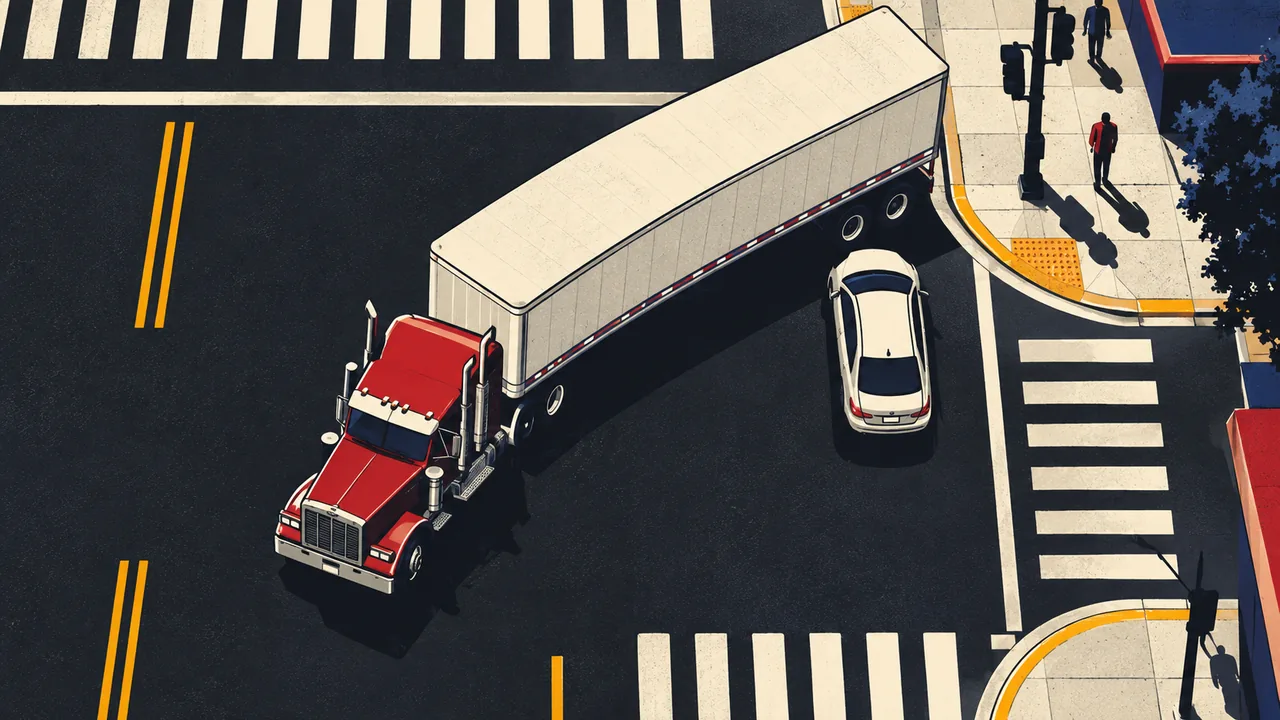
- The squeeze play at intersections. A car pulls up beside a truck that's signaling right, not realizing the truck has to swing left first, and gets squeezed against the curb or a fixed object.
- Not checking the No-Zone before turning. The same right-side blind spot behind blind spot accidents hides cars and people standing right in the turn path. FMCSA's Our Roads, Our Safety guidance on large blind spots names the right side as the largest No-Zone on a tractor-trailer, reaching across more than one lane.
- Missing or misaimed mirrors. 49 CFR § 393.80 requires rear-vision mirrors on both sides that give a view along each side of the vehicle. A mirror that got knocked out of adjustment and never reset is a maintenance and training failure, not bad luck.
- Turning too tight for the trailer. A driver who misjudges the trailer's swing can run the rear wheels over a curb, into a crosswalk, or into a car in the next lane.
- Pedestrians and cyclists in crosswalks and bike lanes are especially exposed, because they're often standing exactly where a trailer's rear wheels track in a tight turn.
Who is liable?
- The driver: didn't signal the wide turn, or didn't check mirrors and blind spots before turning
- The trucking company: poor training on turning procedure for the trailer length in use
- A municipality: in rare cases, an intersection that can't handle commercial turning radii may add a government defendant, with its own shorter notice deadlines
The carrier's own paperwork often decides the case. 49 CFR Part 391 covers driver qualification and requires the carrier to keep a qualification file, including road test and training records. If that file shows the driver never proved they could handle a 53-foot trailer, the claim shifts from one driver's moment of inattention to the carrier's hiring and training practices. That side of the case is better insured and harder to defend. A carrier's past violations are public through the FMCSA Safety Measurement System. See who can be held liable.
What evidence proves the claim
Squeeze-play cases come down to lane position and signal timing in the last few seconds. Witnesses standing on the corner remember that badly. Cameras don't.
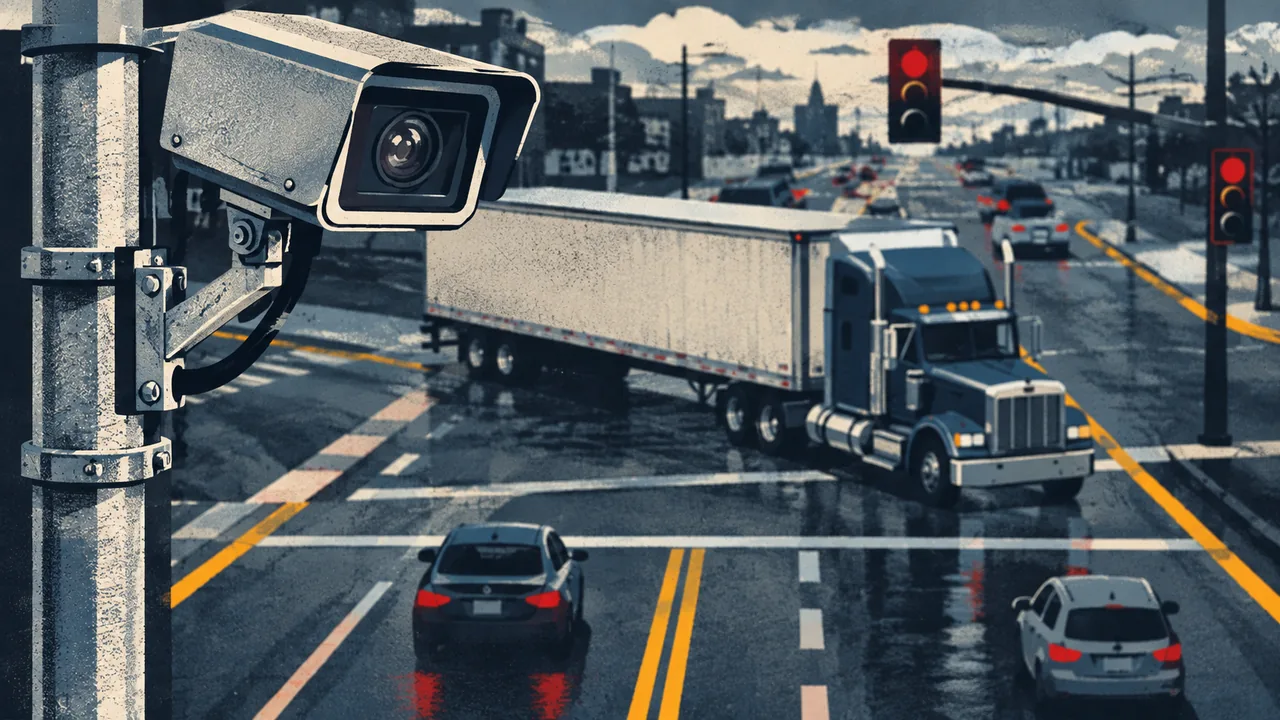
- Intersection and traffic signal camera footage, which shows where the truck was and when its turn signal came on. This is the most valuable evidence in the case, and it's usually recorded over within days.
- Security cameras at nearby businesses. The gas station or bank on the corner often catches an angle the city camera misses.
- The truck's electronic control module, for speed and steering input through the turn.
- Driver qualification and training records under Part 391, covering off-tracking procedure for the trailer in use.
- The trailer length and setup, which decides how far the rear wheels tracked inward.
The footage that decides these cases disappears fastest, so preservation demands should go out within days. If you were in the car or on the bike, note which businesses face the corner and whether you saw a right blinker before the truck moved left. If you were the driver and got hurt in the turn, your own dash cam and your notes on mirror setup matter just as much. Learn what to do next, see how this evidence is obtained on our FMCSA regulations & evidence page, and start a free case review.
Injuries and compensation
Squeeze-play victims get crushed, not just hit, and that leaves a different injury pattern: crush injuries to the lower body, amputation, spinal cord injury, and for cyclists and pedestrians caught under the trailer wheels, too often wrongful death. See what a truck accident settlement covers.
Related causes
Sources
- Our Roads, Our Safety — large truck blind spots (No-Zones) — Federal Motor Carrier Safety Administration
- 49 CFR § 393.80 — Rear-vision mirrors — Electronic Code of Federal Regulations
- 49 CFR § 392.14 — Hazardous conditions; extreme caution — Electronic Code of Federal Regulations
- 49 CFR Part 391 — Qualifications of drivers — Electronic Code of Federal Regulations
- Large Truck and Bus Crash Facts — Federal Motor Carrier Safety Administration
- Large Trucks — fatality facts and crash research — Insurance Institute for Highway Safety (IIHS)
- Safety Measurement System — carrier safety records by BASIC — FMCSA Safety Measurement System
Federal regulations and crash statistics are updated periodically. Figures cited on this page reflect the referenced publications at the time of writing; check the source for the current edition.