Driver fatigue causes big rig crashes when drivers run past federal hours-of-service limits or keep driving while worn out. FMCSA rules cap driving at 11 hours after 10 hours off duty, inside a 14-hour on-duty window. Electronic logging devices record compliance automatically, which leaves a digital trail that can prove violations after a crash.
Picture hour 13 of a 14-hour window. It's 3 a.m., the load is due at a dock two states over by sunrise, and the dispatcher already texted once asking where you are. The white lines start to blur. Your eyes close for what feels like a blink, and when they open the rumble strip is under the drive tires.
Most drivers know that feeling. That's why driver fatigue has been recognized for decades, in FMCSA research and NTSB investigations, as a major factor in serious large-truck crashes. A drowsy driver reacts late, drifts across lanes, and can have "micro-sleeps" of several seconds at highway speed. In an 80,000-pound big rig, a few seconds with nobody really steering is catastrophic.
From the car, it usually looks like a truck that slowly wanders into your lane with no signal, or one that never slows for traffic stopped ahead. If you were in that car, or you're a trucker who got hit by another rig that did it, the question is the same: how long had that driver really been on duty?
Federal hours-of-service (HOS) rules
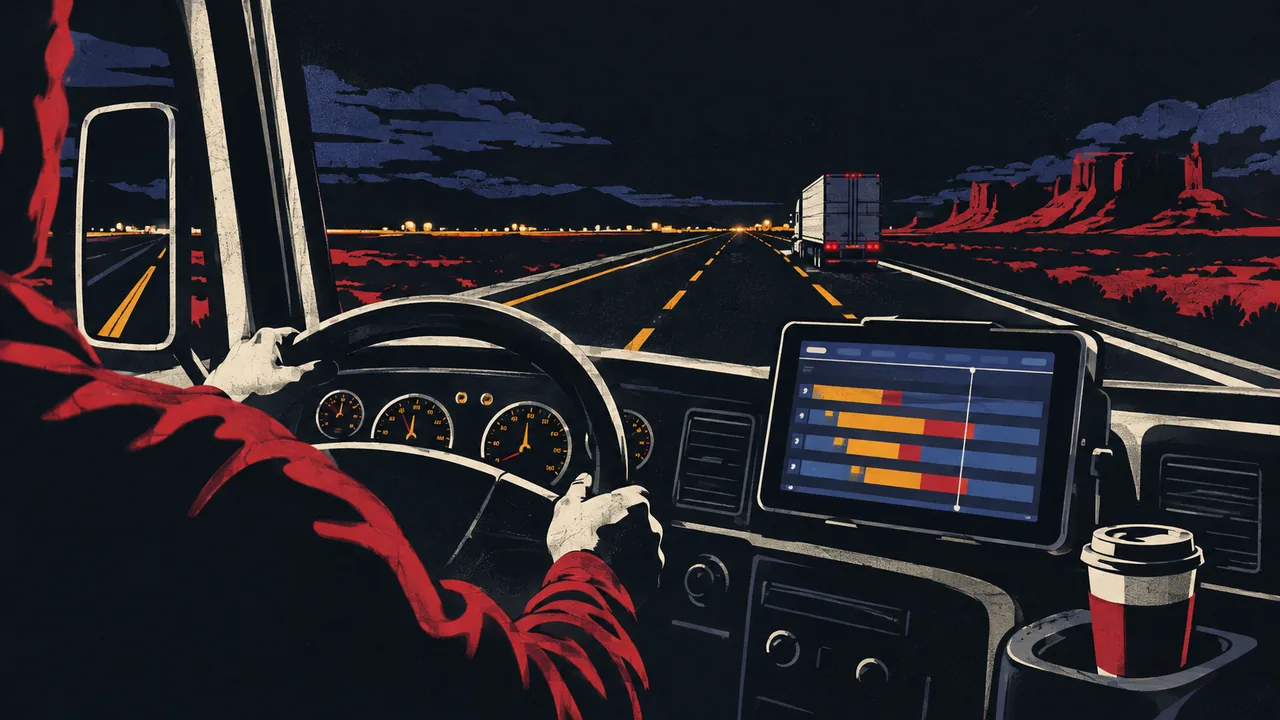
The Federal Motor Carrier Safety Administration limits how long truck drivers can be behind the wheel. The core property-carrier rules (49 CFR Part 395) are:
- 11-hour driving limit after 10 consecutive hours off duty
- 14-hour on-duty window: no driving past the 14th hour after coming on duty
- 30-minute break required after 8 cumulative hours of driving
- 60/70-hour limit over 7/8 consecutive days, reset by 34+ hours off duty
Since the federal ELD mandate, most commercial trucks have to record driving time automatically with an electronic logging device. The paper logbook days, when a driver could "fix" the graph at the next truck stop, are mostly gone. What's left is a digital trail a big rig truck accident lawyer can subpoena and line up against fuel receipts, toll records, GPS pings, and dispatch messages to expose logs that were falsified.
How fatigue is proven after a crash

An ELD shows what the driver was logged as doing. The job is to find out what they were actually doing. That means pulling records from places the driver and carrier don't control and seeing whether the story holds up:
- ELD / hours-of-service logs and their edit histories (who changed a duty status, and when)
- The truck's event data recorder (black box): speed, braking, and steering inputs before impact
- Dispatch and delivery schedules showing deadlines that couldn't be met legally
- Cell phone records and receipts placing the driver on duty longer than logged
- Witness testimony of drifting, weaving, or late braking
A fuel stop at 11 p.m. in one state and a weigh station crossing a few hours later, when the log shows the driver in the sleeper berth, is the kind of gap that breaks a fatigue case open.
Who is liable for a fatigue crash?

The driver is rarely the only one responsible. Trucking companies have been found liable for pressuring drivers to break HOS limits, setting delivery windows that can't legally be met, ignoring log falsification, or paying per-mile structures that reward pushing through exhaustion.
If you drive for a living, you know how that pressure works. When a carrier's scheduling caused the violation, the claim reaches the company and its much larger insurance policy, not just the person in the seat. See who can be held liable after a big rig accident.
Why timing matters

ELD data only has to be kept for a limited time, and carriers routinely overwrite or toss records once retention windows lapse. A preservation letter sent early freezes that evidence.
So if you were hurt, whether you were in a car or in your own cab, write down what you remember now: the time, the truck's company name on the door, anything you saw it do before impact. Then get a free case review before the records disappear.
Related causes
- Jackknife accidents: fatigue-delayed braking is a common trigger
- Brake failure
- Tire blowouts
Sources
- 49 CFR § 395.3 — Maximum driving time for property-carrying vehicles — Electronic Code of Federal Regulations
- 49 CFR § 395.8 — Driver's record of duty status — Electronic Code of Federal Regulations
- Electronic Logging Devices (ELD) rule and technical specifications — Federal Motor Carrier Safety Administration
- 49 CFR Part 391 — Qualifications of drivers — Electronic Code of Federal Regulations
- Large Truck and Bus Crash Facts — Federal Motor Carrier Safety Administration
- Safety Measurement System — carrier safety records by BASIC — FMCSA Safety Measurement System
Federal regulations and crash statistics are updated periodically. Figures cited on this page reflect the referenced publications at the time of writing; check the source for the current edition.