A truck crash in Los Angeles & the Inland Empire is a California claim: 2 years to file in most cases and pure comparative negligence. Big Rig Lawyer connects people hurt here with attorneys licensed in California; we are a referral service, not a local law office.
You might be a drayage driver pulling a box off a terminal in San Pedro, or a family on the 60 heading home to Riverside. Either way, the trucks around you are moving the country's imports, and the companies behind them are often a tangle of carriers, brokers and warehouses.
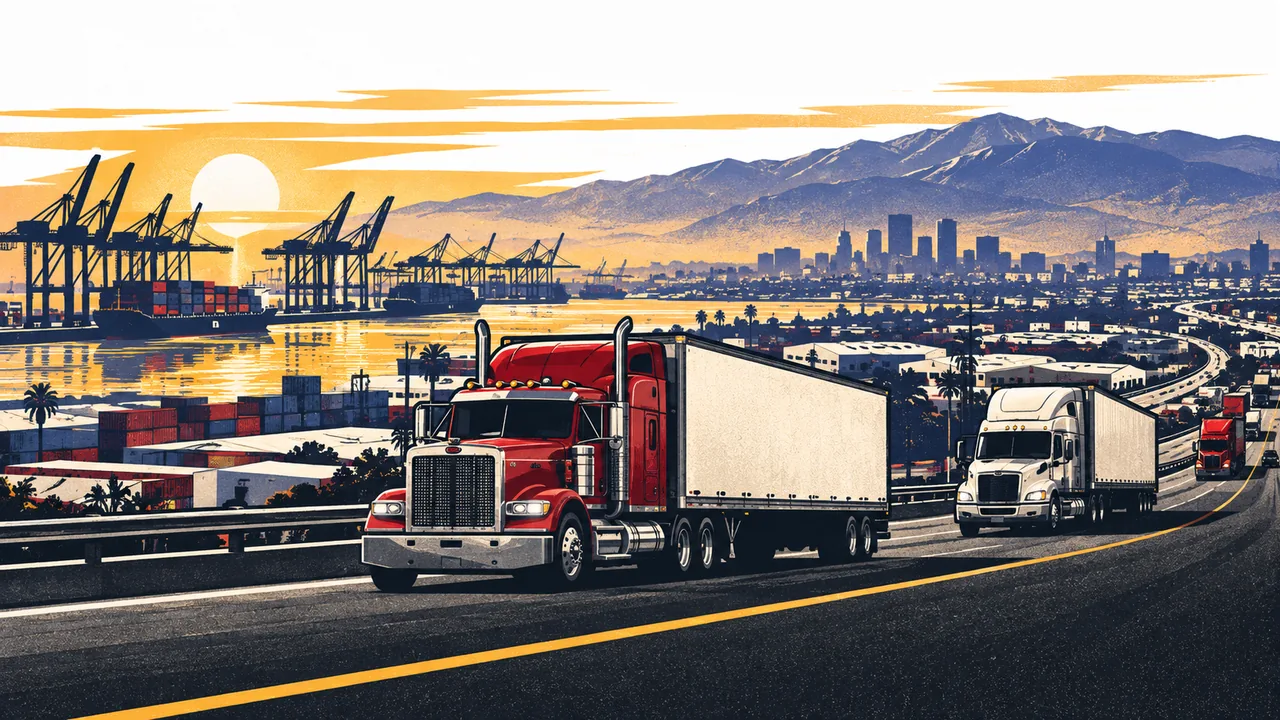
Driving Los Angeles & the Inland Empire: what the roads are really like
Freeways here are crowded most of the day. The 710 is full of container trucks from before sunrise, and the 60 and 91 back up for miles when commuters head inland. Trucks make up a big share of traffic near the warehouses, and they're often in a hurry to make appointment windows.
Weather is usually mild, but it bites in specific ways. Santa Ana winds can push high-profile trailers around, especially through the Cajon Pass and Fontana. The first rain after a dry spell leaves an oily film on the road, and fog can settle in the pass and inland valleys without much warning.
Where big rig wrecks cluster in Los Angeles & the Inland Empire
- I-710 Long Beach Freeway. The main truck route out of the ports, packed with container trucks heading to rail yards and warehouses.
- SR-60 / SR-57 confluence (Diamond Bar). The two freeways share lanes for a short stretch, forcing heavy weaving between trucks and commuters.
- I-10 and I-15 through Ontario and Fontana. The heart of the warehouse belt, with constant truck turns onto and off the freeway.
- I-15 Cajon Pass. Steep grades, strong winds and fog where heavy trucks and fast traffic mix.
The freight behind Los Angeles & the Inland Empire truck traffic
The Ports of Los Angeles and Long Beach together form the busiest container port complex in the country. Containers leave by the Alameda Corridor rail line or by truck up I-710 and the 110. Much of that cargo lands in the Inland Empire, where Ontario, Fontana, Rialto and nearby cities host some of the biggest warehouse clusters anywhere. Rail yards in the IE and near the ports keep drayage trucks moving at all hours.
Main truck routes: I-710 (Long Beach Freeway) · SR-60 (Pomona Freeway) · I-10 · I-15 · SR-91.
If you were driving the truck
Drayage drivers in this region are sometimes classified as independent contractors and sometimes as employees, and it's not always clear which label is right. If you got hurt, keep your lease or contract, settlement statements, your terminal gate tickets and container numbers. Save texts from dispatch about that load. An attorney can look at all of it to figure out who controlled your work and which insurance applies.
If a big rig hit your car
If a truck hit you on a Southern California freeway, the CHP report will likely be the starting point. Take photos of the cab, the trailer and the container, including any container number on the box. Those numbers can connect the truck to a shipping line and a warehouse. Get the names of witnesses, keep every medical bill, and don't give a recorded statement to the trucking company's insurer until you've talked to an attorney.
Local moves that protect a Los Angeles & the Inland Empire claim
- The California Highway Patrol usually handles crashes on freeways in the region. On city streets, it's usually the local police department, such as LAPD or Long Beach police. In unincorporated areas and contract cities, the county sheriff may respond. Confirm the agency at the scene and get the report number.
- Container numbers (four letters plus seven digits) on the box can link the truck to a shipping line and terminal.
- Warehouse and terminal gate cameras often capture trucks coming and going; note the nearest facility name.
- Caltrans has freeway cameras across the region; ask an attorney about requesting footage quickly.
California rules still decide the case
California is a pure comparative state. Even a claimant found 90% at fault may recover the remaining 10% of their damages — there is no percentage that bars recovery outright.
Read the full California truck accident guide and the California filing deadlines, or start a free case review.
Other California metros
Sources
- Large Truck and Bus Crash Facts — Federal Motor Carrier Safety Administration
- SAFER Company Snapshot — carrier safety records — Federal Motor Carrier Safety Administration
Federal regulations and crash statistics are updated periodically. Figures cited on this page reflect the referenced publications at the time of writing; check the source for the current edition.